Showing posts with label last mile delivery. Show all posts

Thursday, May 18, 2023

Enhancing Customer Experience through Real-Time Tracking and Delivery Notifications

 Customers have grown to expect perfect and transparent delivery experiences when purchasing things online in today’s fast-paced environment. The ability to track orders in real time and receive timely alerts regarding the status of their delivery has become an important component in determining consumer happiness and loyalty. This blog article looks at how organizations may improve the customer experience by using real-time tracking and delivery alerts.

The Importance of Real-Time Tracking:
Customers may track the status of their orders in real-time from the time they are sent until they arrive at their door. This amount of transparency not only alleviates worry and uncertainty but also gives the recipient a sense of control over the delivery process. Businesses may provide a helpful tool to clients by adopting real-time tracking.

a) Greater Transparency: Real-time tracking gives clients precise and up-to-date information on the whereabouts of their products. They may see the status of their deliveries, anticipate arrival times, and, in certain situations, follow the delivery truck. Customers feel more engaged in the delivery process, which increases trust and confidence in the firm.

b) Proactive Problem Solving: With real-time tracking, organizations can quickly discover possible delivery difficulties or delays.

If a product is delayed unexpectedly, firms may contact the consumer in advance, offering information and options to guarantee a smooth resolution. Businesses may reduce customer irritation and avoid unwanted experiences by responding to issues in real-time.

The Role of Delivery Notifications:
Delivery notifications serve as a bridge of communication between businesses and customers, delivering timely information on the progress of their purchases. These messages may be delivered by email, SMS, or mobile applications, keeping consumers informed and engaged throughout the delivery process.

a) Order Confirmation: Customers love receiving an order confirmation message as soon as they place a purchase. This initial contact reassures consumers that their transaction was completed successfully and sets the tone for a great customer experience. Order data, expected delivery dates, and other pertinent information such as tracking numbers or links might be included in the message.

b) Shipment Updates: Regular updates on delivery progress are critical for keeping consumers informed. Notifications can be sent when a shipment is picked up, ready for delivery, or has been delayed. Businesses demonstrate their dedication to client pleasure and openness by providing accurate and timely information.

c) Delivery Confirmation: Once the shipment has been properly delivered, the final touchpoint is a delivery confirmation notification. It not only verifies the order’s fulfillment but also provides a chance to collect comments or provide follow-up instructions. A well-crafted delivery confirmation message assists businesses in leaving a great impression on customers, boosting the possibility of future purchases.

Advantages for Businesses:
Implementing real-time monitoring and delivery alerts not only enhances the client experience but also provides organizations with various benefits:

a) Increased customer happiness and loyalty: Businesses may increase customer happiness by delivering a clear and hassle-free delivery experience. Satisfied customers are more likely to become devoted advocates who not only make repeat purchases but also suggest the company to others. Positive word-of-mouth may have a big influence on a brand’s reputation and bring in new consumers.

b) Fewer customer support inquiries: real-time tracking and delivery alerts help minimize the number of order status-related customer support inquiries. Businesses that provide proactive updates enable consumers to access information on their own, reducing the need for help. This permits customer service representatives to devote more time to other tasks.

c) Analytics and Data Insights: Using real-time tracking and delivery alerts generates useful data and insights. Businesses may spot patterns, optimize delivery routes, and streamline operations by analyzing this data. Such insights help firms make data-driven decisions that improve supply chain efficiency, delivery speed, and customer experience.

Best Practices for Implementing Real-Time Tracking and Delivery Notifications:

Businesses should consider the following best practices to guarantee a smooth and effective adoption of real-time tracking and delivery notifications:

a) Select the Best Technology Solution: Compare several technology solutions that provide real-time tracking and delivery notification capabilities. Consider integration with current systems, scalability, dependability, and compatibility with customer communication channels. Choose a solution that is compatible with your business requirements and can provide a seamless experience for both customers and internal teams.

b) Clear and Clear Communication: Create notifications that are succinct, clear, and easy to understand. Provide essential information such as order details, tracking numbers, projected delivery timings, and any potential delays in straightforward language. Make sure the alerts are aesthetically appealing and consistent with the tone and design of your business.

c) Personalization and customization: When feasible, personalize alerts. Customers should be addressed by name, and alerts should be tailored to their preferences. Provide clients with the choice of selecting their preferred communication methods, such as email, SMS, or mobile applications. Customization gives a personal touch while also improving the overall client experience.

e) Continuous Improvement: Monitor and analyze customer feedback, delivery performance indicators, and any customer-reported concerns regularly. Use this information to find areas for improvement and make the required changes. Strive to improve the delivery experience by staying current on developing technology and industry trends.

Conclusion:

In today’s increasingly competitive e-commerce industry, improving the consumer experience through real-time tracking and delivery alerts is critical. Businesses may boost transparency, reduce consumer concern, and develop trust and loyalty by applying these solutions.

Customers are not the only ones who profit; organizations may achieve operational savings, minimize support inquiries, and obtain important data insights. Businesses must pick the correct technological solution, communicate, personalize messages, and handle difficulties to successfully adopt real-time tracking and delivery notifications.

Get a FREE Trial of delivery software

Monday, May 15, 2023

Streamlining Communication Channels in Last Mile Delivery using Fleetroot


In today’s fast-paced and competitive industry, efficient last-mile delivery is critical for organizations. Effective communication channels are critical for achieving flawless operations.

Fleetroot, a cutting-edge fleet management software, provides a comprehensive solution for improving last-mile delivery communication.

In this article, we will examine how Fleetroot increases communication, coordination, and overall efficiency in the last-mile delivery process.

Tracking and monitoring in real-time
Fleetroot allows delivery vehicles to be tracked and monitored in real-time, delivering accurate and up-to-date information on their location, status, and performance.

This data can be shared with clients, dispatchers, and other stakeholders, increasing transparency and decreasing the need for ongoing follow-up. Real-time tracking keeps customers informed about the status of their deliveries, allowing them to plan ahead of time and avoid waiting.

Route Planning and Optimisation
The route optimization tool in Fleetroot assists delivery companies in planning the most efficient routes for their drivers. The software proposes optimized routes that save travel time and fuel usage by taking into account aspects such as traffic conditions, delivery priority, and vehicle capacity.

These routes can be given to drivers directly, eliminating the need for manual route planning and lowering the likelihood of errors or delays. Efficient route planning ensures on-time delivery, increases customer happiness, and boosts fleet productivity.

Seamless Communication with Drivers
Through its mobile app, Fleetroot enables smooth communication between dispatchers and drivers. Dispatchers may give drivers’ smartphones instructions, updates, and delivery specifics, eliminating the need for phone calls or text messages. Drivers can also deliver status updates in real time.

Notifications and Feedback from Customers
Fleetroot provides automated customer notifications that keep them up to date on the status of their deliveries. Customers receive timely updates, such as projected arrival times and any modifications or delays, via SMS or email. By offering openness and managing expectations, this proactive communication creates trust and consumer pleasure.

Furthermore, Fleetroot allows customers to offer feedback on their delivery experience, assisting businesses in monitoring and improving service quality.

Third-party Application Integration
Fleetroot’s adaptability is increased further by its smooth interface with a variety of third-party applications. It can connect to customer relationship management (CRM) systems, e-commerce platforms, and other software solutions, allowing for data sharing and process simplification.

This integration avoids human data entry, decreases effort duplication, and improves overall efficiency. Integrating with CRM systems, for example, enables firms to synchronize customer data, track order history, and create personalized delivery experiences.

Conclusion
Communication channel optimization is critical for optimizing last-mile delivery processes. With its comprehensive features and capabilities, Fleetroot enables organizations to accomplish effective communication, and better coordination, and increase overall production.

Fleetroot delivers a comprehensive solution for improving communication in the last-mile delivery process by integrating real-time tracking, route optimization, smooth driver communication, customer notifications, and connectivity with third-party applications. By using Fleetroot, organizations can provide outstanding customer experiences, cut costs, and remain competitive in the fluctuating environment of last-mile delivery.

Get FREE Trial of last mile delivery software

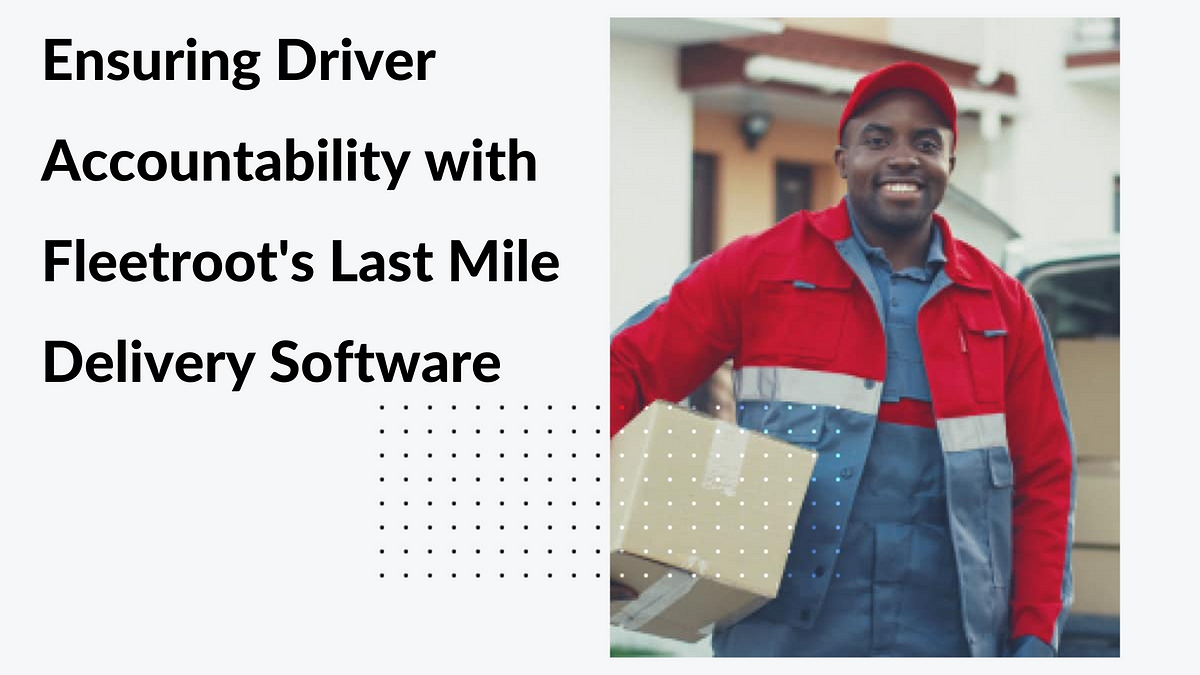
Ensuring Driver Accountability with Fleetroot's Last Mile Delivery Software


Ensuring Driver Accountability with Fleetroot’s Last Mile Delivery Software

In the fast-paced world of last-mile delivery, organizations must ensure driver accountability to preserve efficiency, customer happiness, and overall operational success. Fleetroot’s Last Mile Delivery Software provides a comprehensive solution that enables businesses to easily monitor and enforce driver accountability.

Fleetroot enables organizations to optimize their delivery operations and overcome typical issues connected with fleet management by integrating advanced tracking technology, real-time data insights, and streamlined communication tools. In this blog article, we will look at Fleetroot’s Last Mile Delivery Software and how it improves driver accountability in the delivery ecosystem.

Real-time Driver Tracking
Fleetroot’s Last Mile Delivery Software enables organizations to follow their drivers’ activity throughout the delivery process in real-time. Companies can use GPS tracking to determine the actual location of each driver at any given time, ensuring that they stay on schedule and follow allocated routes.

This function not only helps to avoid unauthorized stops and deviations, but it also allows for quick responses to any unexpected events, such as traffic congestion or supply delays.

Furthermore, the real-time tracking tool improves driver responsibility by providing precise information on arrival times, idle periods, and overall performance. Managers can view thorough reports that examine driver behavior such as speeding, forceful braking, and excessive idling. Companies can take proactive actions to address and change these behaviors by identifying them.

Route Planning and Optimisation
Fleetroot’s Last Mile Delivery Software provides powerful route optimization and planning capabilities, allowing organizations to maximize productivity while minimizing delivery time. The software suggests the best routes depending on numerous parameters such as distance, traffic conditions, and delivery priorities by employing clever algorithms.

This function not only ensures on-time deliveries but also fosters driver accountability. Drivers are less likely to divert or take unauthorized breaks when they follow a predetermined and optimized route.

Additionally, the program allows managers to define geofences and virtual borders, warning them whenever a driver deviates from the intended route or makes an unplanned stop. Such proactive monitoring promotes driver accountability and assists businesses in maintaining the highest levels of service quality.

Proof of Delivery
Last Mile Delivery Software from Fleetroot includes a strong proof of delivery function that eliminates disagreements and gives concrete documentation of completed deliveries. After completing a delivery, the software allows drivers to capture and submit images, customer signatures, or barcode scans, ensuring a transparent and verifiable record of the transaction.

This function not only improves customer satisfaction but also contributes significantly to driver accountability. Companies can efficiently address any consumer complaints or disputes if they have recorded proof of every delivery. Furthermore, drivers are aware that their actions and service quality are being recorded, which encourages them to carry out their responsibilities thoroughly and properly.

Communication and Alerts
Effective communication is critical in last-mile delivery operations to ensure driver accountability. Fleetroot’s Last Mile Delivery Software facilitates real-time updates, notifications, and alerts by providing seamless communication channels between drivers and supervisors.

Managers may quickly transmit vital information, such as delivery updates, route adjustments, or unforeseen incidents, using instant messaging and push notifications. Similarly, drivers can express any issues or concerns they have while on the road, allowing managers to provide quick assistance or make required adjustments.

The communication and notifications function promotes driver responsibility greatly by keeping drivers informed and aware of their responsibilities. It promotes a collaborative work atmosphere in which drivers feel encouraged and connected, resulting in enhanced overall performance and a sense of accountability to both employers and employees.

Last Mile Delivery Software from Fleetroot provides a comprehensive set of tools that improve driver responsibility in last-mile delivery operations. Businesses may monitor driver activity in real-time, identify areas for improvement, and handle any risky or inefficient driving behaviororr.

The route optimization and planning functions in the program allow businesses to optimize delivery routes, eliminate deviations, and promote adherence to established schedules, fostering driver accountability and on-time performance.

Fleetroot’s software’s proof of delivery feature reduces disagreements and ensures a transparent record of completed deliveries. This improves consumer happiness while also holding drivers accountable for their conduct. Companies can provide verifiable evidence of successful delivery by taking photos, signatures, or barcode scans, efficiently addressing any consumer complaints or problems.

Maintaining driver accountability requires effective communication, and Fleetroot’s platform provides seamless communication channels between drivers and management. Instant messaging and push alerts help drivers stay informed and engaged by providing timely updates, route adjustments, and support. This instills in drivers a sense of duty and accountability, which leads to enhanced overall performance and client service.

Finally, Fleetroot’s Last Mile Delivery Software provides an all-inclusive solution for ensuring driver responsibility in last-mile delivery operations.

Businesses may monitor and optimize their delivery operations, increase driver performance, and provide a smooth experience for customers by utilizing real-time tracking, route optimization, proof of delivery, and effective communication tools.

Companies can improve their last-mile delivery operations and achieve improved efficiency, customer happiness, and overall success by utilizing Fleetroot’s software.

Get a FREE Trial of last mile delivery software


Smart Tracking Solutions for Last Mile Delivery: An Introduction to Fleetroot


Last mile delivery has become an important component of client satisfaction in the fast-evolving world of e-commerce. Businesses are increasingly turning to smart tracking technologies to optimize this critical stage. Fleetroot is one such innovative platform. In this blog, we will present Fleetroot and discuss its features, benefits, and how it may transform last-mile delivery operations.

What exactly is Fleetroot?
Fleetroot is a complete delivery management and tracking solution created exclusively for last-mile delivery operations. It optimizes the entire delivery process by utilizing cutting-edge technologies such as GPS, real-time tracking, and advanced analytics. Fleetroot seeks to improve operational efficiency, boost customer satisfaction, and reduce expenses by offering enterprises actionable analytics and automation possibilities.

Fleetroot’s main characteristics are as follows:

Real-Time Tracking: With Fleetroot, businesses can track the position and status of their cars in real time. This tool provides businesses with total visibility over their fleet, allowing them to make informed decisions and give consumers with precise delivery updates.

Route Optimisation: Fleetroot optimises delivery routes by taking into account factors like traffic, distance, and delivery time windows. This function assists businesses in reducing fuel usage, shortening delivery times, and improving overall efficiency.

Geofencing: Businesses can use Fleetroot to construct virtual limits or geofences around specified places. This function allows them to monitor when a vehicle enters or exits designated regions, assuring delivery schedule compliance and increasing security.

Analytics and Reporting: Fleetroot delivers detailed analytics and reporting on different elements of fleet management, such as driver behavior, fuel use, vehicle maintenance, and delivery performance. These insights assist companies in identifying areas for improvement and making data-driven decisions.

Mobile Applications: Fleetroot provides user-friendly mobile applications for both drivers and fleet managers. Drivers can view real-time data, receive delivery instructions, and report any problems. On the move, fleet managers may monitor the fleet, connect with drivers, and access analytics.

Fleetroot Advantages

Improved Efficiency: Fleetroot’s features simplify last-mile delivery procedures, resulting in increased efficiency and production. Routes can be optimized, idle time reduced, and fuel consumption reduced, resulting in cost savings and enhanced profitability.

Enhanced Efficiency: Fleetroot’s features streamline last-mile delivery 
Improved Customer Experience: Fleetroot’s real-time tracking and accurate delivery updates improve the customer experience by providing transparency and dependability. Customers can track their delivery in real-time and receive realistic predicted arrival timings, improving their satisfaction and loyalty.

Enhanced Security: Fleetroot’s geofencing technology improves security by allowing organizations to monitor vehicle movements and detect any unauthorized activity. It also aids in the recovery of stolen vehicles by providing real-time location information.

Data-Driven Decision Making: Fleetroot’s extensive analytics and reporting capabilities enable enterprises to make data-driven decisions. Businesses can detect bottlenecks, optimize resource allocation, and improve overall fleet performance by analyzing performance metrics and driver behavior.

Communication Simplified: Fleetroot’s mobile applications enable smooth communication between fleet managers and drivers. Real-time updates and instant messaging ensure effective cooperation, reducing errors and delays.

In the competitive market of last-mile deliveries, smart tracking technologies such as Fleetroot play a critical role in optimizing operations. Fleetroot enables businesses to improve efficiency, boost customer happiness, and make data-driven choices by leveraging the power of real-time tracking, route optimization, and advanced analytics.

Implementing Fleetroot may transform last-mile delivery operations, resulting in cost savings, enhanced performance, and a competitive advantage in the marketplace.

Get a FREE Trial of last mile delivery software


Thursday, February 2, 2023

How Do I Optimize My Last-Mile Delivery And Make It Profitable?


Is Last-Mile Delivery Profitable?

While consumer expectations for delivery are high, the expenses involved with achieving such expectations are also rising. Aside from escalating complexity and delivery inefficiencies, firms must contend with increasing last-mile delivery prices.

Last-mile delivery is the most costly and time-consuming aspect of the supply chain. According to statistics, the cost of the last mile of your product's delivery accounts for more than 53% of overall delivery expenses. Furthermore, depending on how short the advertised delivery time frames are, the cost of last-mile deliveries might climb by two to four times. All of these high last-mile delivery costs eat into profitability. Inefficiencies in delivery operations might lead to exorbitant costs if not optimized.

Furthermore, e-commerce enterprises and logistics suppliers cannot pass the expense burden onto customers because this would make them disgruntled and dissatisfied. To retain a healthy profit margin, firms must take proactive initiatives to increase the efficiency of their last-mile delivery services and lower delivery costs.

Another survey found that 84% of buyers are unwilling to buy from a firm again if they had a terrible delivery experience. Furthermore, more than 98% of customers believe that last-mile delivery is critical to brand loyalty.

As a result, last-mile delivery efficiency is vital for every e-commerce or logistics company with a delivery component. Now, let's talk about how you may optimize your last-mile delivery operations with the correct tools, methods, and strategies.

How Can You Improve Your Last-Mile Delivery?

The following are five tried-and-true methods for optimizing your last-mile delivery services:

Delivery Drivers Can Be Outsourced

Consumer demand for same-day self-service delivery is skyrocketing.
Suppose you need to get your own fleet. In that case, an outsourced delivery platform can help you identify independent drivers who can pick up orders from your stores or warehouses and deliver them straight to your consumers.

The cost advantages of contracting deliveries to independent drivers are obvious. Because the costs of employee-related taxes, insurance, and benefits are so high, hiring freelance drivers for last-mile deliveries is less expensive than keeping in-house drivers. Furthermore, independent drivers offer their own vehicles and are responsible for vehicle repairs, which saves you a significant amount of money.

Another advantage of outsourcing drivers is that you may adjust to changing consumer demand without incurring continuous fixed expenditures. As a result, you may hire more drivers during high seasons and reduce your workforce when revenue slows.

A unified dashboard that displays real-time truck and order statuses can provide visibility and seamless delivery to your consignees. A unified last-mile delivery software solution provides a consolidated dashboard that assists businesses in managing all drivers, whether owned or outsourced.

Plan the Best Routes (Effective Route Planning)

When a company has thousands of deliveries scheduled every month, the routes that those deliveries take must be considered.

To create the best routes, you must consider numerous factors, including traffic congestion in densely populated regions, construction closures, and the availability of alternative routes.

Monitor Your Vehicles and Drivers

Careless drivers can raise your last-mile delivery expenses by wasting time and fuel. A business GPS tracking system displays your drivers' current location in real-time, allowing you to always validate what they are doing.

Furthermore, it informs you if a vehicle malfunction, an accident, or an emergency occurs during delivery. This visibility can assist you in resolving delivery delays as quickly as possible and minimizing losses.

Some last-mile delivery software systems provide a re-optimization tool that allows you to re-route routes and assign another driver closest to the impacted client to complete the delivery on time.
Customers should have last-mile visibility.

Provide Last Mile Visibility to Customers

Customers increasingly want greater transparency into last-mile deliveries (that is, the visibility a customer has over his delivery). They anticipate a high degree of visibility and experience, such as being able to view a real-time map on their mobile phones, track the driver as he travels, and know exactly when he will arrive. Customers should also be able to follow the progress of their deliveries using a tracking number or their Account ID. Direct connection with the driver, for example, is a significant customer engagement component.

Keep Proof of Delivery

With large delivery volumes, businesses want greater insight and transparency into the last-mile delivery process. An Electronic Proof of Delivery enables businesses to preserve a verifiable record of when deliveries are delivered. Before leaving the last-mile delivery site, the system requires the driver to obtain a signature and scan a bar code. As a result, electronic Proof of Delivery reveals when drivers deliver parcels, who signs them, and where they are deposited. This data is then sent to a centralized system and logged. If a consumer alleges that the item was not delivered, the corporation has documentation of delivery.

To recap, you should invest time and effort in optimising last-mile delivery in order to give a wonderful delivery experience to your clients and assure recurring business. The five methods listed above have been shown to be quite successful in optimising last-mile deliveries. So, are you willing to invest in the best delivery software to improve your last-mile deliveries?

What Are The Challenges Of A Last Mile Delivery System?


As the term suggests, ‘last mile delivery’ is the last link in the supply chain that a package goes through before it is delivered to its end customer.

Since it often accounts for almost 50% of the cost of a supply chain and is also the most complex and challenging part, a logistics and delivery company needs to understand the many challenges of last-mile delivery operations.

With the fully automated Last Mile Delivery Management Software not only helps to understand these challenges and factors but digitizes (and brings them online) the entire process so that fleet managers can maintain holistic control over it.

What are the biggest challenges in last-mile delivery?

1) Changing customer requirements: The delivery requirements of modern clients have undergone a full transformation. The days of "4-6 business days for delivery" or "your order is out for delivery" are over! It's all about "24-hour delivery" and "same-day delivery" these days, thanks to e-commerce behemoths like Amazon. Not only that, but consumers also want to be kept up to date in real-time on the status of their packages (e.g. via in-app notifications or SMS alerts). Additionally, Logistics & Distribution companies must account for shifting client schedules and delivery windows, as well as customization.

2 ) Delivery costs the last mile: As previously stated, the rising needs of quickly changing client expectations place enormous strain on supply-chain networks. Even if buyers are ready to pay the extra fees for such fast shipping choices, maintaining such an exacting delivery network remains a tremendous logistical challenge.

Last-Mile Delivery charges can account for up to 40% of a company's total delivery cost. While this is passed on to the end consumer, the execution difficulty remains, particularly given the number of dynamic variables that are continually altering supply-chain networks and, in particular, last-mile logistics. Furthermore, in circumstances where the expenses cannot be passed to the end customer, such as failed or late deliveries, rejected deliveries (and so on), the costs must be borne by the transport company.

3. Real-Time Visibility: In years past, service managers had limited control or “visibility” of the delivery process once packages or vehicles were ready for delivery. They relied on drivers calling from pit stops or keeping daily activity logs. This resulted in inefficiencies such as communication gaps, the ability to resolve issues/emergencies on the fly, maintaining a high level of route optimization, and harmful practices (etc.).

And with increasing competition and today’s complex global chains, such inefficiencies could easily become major problems.

In addition, today’s customers also want to be informed about the movement of their packages throughout the delivery process. process, especially the last mile. Where is your driver, how long will it take, the final ETA — they want to know everything!

While the introduction of this feature can be credited to companies like
Uber, customers of all stripes now expect this very accurate service for all your deliveries! No pressure!

This type of “real-time demand” puts tremendous pressure on the supply chain network, and while it’s one thing when everything goes according to plan, it creates new stress and problems when it does the case is the actual schedules differ from the forecast ones.

4) Route Optimization: Several reasons continually put pressure on Logistics & Distribution organizations to manage their daily deliveries. In such a case, the only option is to employ advanced (automatic) Route Optimization algorithms.

The process of determining the most effective route between two delivery destinations is referred to as route optimization. Remember that the most efficient route is the one that balances all such factors to arrive at the most cost effective and efficient way, not the one that is the shortest, cheapest, or fastest.

Because all of the problems (and inefficiencies) of a supply-chain network build up and influence last-mile delivery logistics, employing a solution like Route Optimization Software is critical in controlling them. Without this, Fleet Managers would be unable to satisfy the complicated requirements of a delivery network in modern times.

5) Changing Variables: The unpredictability of the factors on which a supply-chain network is based is perhaps the most difficult part of it.

Weather and traffic patterns are always changing.

Performance and availability of drivers

Vehicle accessibility

The availability of resources (on-site teams, warehouse teams)

Infrastructure (warehouse, road repair/building)

All of the above variables are continually changing (e.g., a sudden storm, or an accident), impacting the (lack of) predictability of last-mile delivery logistics. This has an impact on timetables, pricing, and delivery dates.

As a result, Fleet Managers must maintain real-time contact not just with their internal teams but also with their customers. Using GPS-enabled last-mile delivery software that automates the entire delivery process in real time is another important tool.

6) Use of modern technology: With increased competition and increasingly demanding customers, current technologies such as an automated, cloud-based Last-Mile Delivery system are necessary. This software balances all of the factors and assists Logistics and Distribution companies in staying on top of their delivery operations.

Get 14 days FREE Trial of the best delivery software

Monday, January 23, 2023

How To Solve The Last Mile Problem With Scalable Logistics Technology


Recent years have seen a sharp increase in the logistics and distribution sector, with rising e-commerce serving as a major driver. To keep up with their clients’ complicated needs and quickly expand company development, logistics organizations have also had to incorporate new technology like scalable logistics systems.

I. Why is last-mile scalable logistics technology so crucial?

To see how quickly the logistics and distribution sectors have expanded in recent years, one simply has to glance around. The emergence of eCommerce and the abundance of options it provides customers from the comfort of their homes has fueled the exponential growth of the global retail sector.

As a result, businesses in the logistics and distribution sector — those that deliver packages to customers’ homes — have expanded. They have had to pay particular attention to their operations because challenges come with every opportunity. The last-mile delivery is crucial in this context. It has gotten to the point where customers increasingly depend on their decision to purchase online at one website over another on how quickly and cheaply their orders are fulfilled.

While many businesses have figured out how to successfully fill client orders by managing an effective last-mile operation, many others still need help. And when businesses start to grow their operations, this fight intensifies greatly.

Since the expansion of e-commerce shows no indications of slowing down anytime soon, businesses must streamline their last-mile operations. This has increasingly entailed installing cutting-edge, automated systems that can handle scale-up needs.

According to studies, 93% of customers want to be informed in real-time as soon as their item leaves the warehouse and until it reaches their destination.

What are some of the biggest obstacles to growing last-mile logistics?

Scaling up is the most challenging stage of a company’s growth, as experts will frequently inform you. This stage lacks the agility of a startup and the stability and resources of an established company. There are numerous difficulties, and there is constant pressure on the answers. Scale-up problems frequently include:

Rising order quantities and ongoing demand for resources
expanding client base with many, quickly evolving tastes
Need for complete visibility and openness across the whole last-mile operation
unpredictable operations, such as when fleet vehicles are in motion
High running costs for last-mile services

III. Using scalable logistics technology to address the issue of the last-mile

Deliveries must be automated due to the size and complexity of today’s distribution and logistics networks. To achieve a successful last-mile delivery operation, start here. In all processes, this optimizes the effort, resources, and time needed.

Route planning, real-time tracking, customer communication, delivery dispatch, data collecting, and analysis, comparing actual performance to planned performance, and other tasks are made more accessible by choosing the right logistics technology system. Through the use of cloud technology, fleet managers can keep an eye on this from a central dashboard. Making timely and informed judgments is facilitated by this. In a word, such a solution provides you with all the resources needed to successfully expand your firm.

Let’s examine the top 4 approaches to doing so:

2. Constantly changing consumer preferences: They are reflected in live customer updates. Because e-commerce behemoths like Amazon and Walmart pamper consumers with incredibly quick deliveries, sometimes at no extra cost, it has undergone a substantial transition in current times.

As a result, people now expect more from their brands, including a wide range of shipping options, times, and windows in addition to quick and dependable shipment at reasonable prices. They also want to be informed in real-time on the status of their goods, which is equally important. A last-mile logistics program can accomplish all of this with ease.

3. Live tracking: The real-time monitoring of fleet, cargo, and driver movement is one of the most significant advancements of contemporary automated software over earlier iterations.

Fleet managers use GPS-enabled equipment to monitor drivers and cars on a map. They have real-time data on their cargo pickup, delivery of customers, and order-closing processes.

This is a crucial component of scalable technology. Not only can you determine whether your initial hypotheses or forecasts are accurate, but if not, you can also analyze any deviations in real-time to create future plans that will be more successful.

4. Cloud technology: To cut a long story short, a firm won’t be able to scale up its last-mile solutions without adopting a logistics solution based on cloud technology.

On-site server-based technology is no longer used as often as it once was. To build a linked network or system, an on-site server system will initially require several additional physical on-site servers across all of your touch points.

Teams from across the world may simply use a cloud-based logistics system that is located there. All data is taken, uploaded in real-time, and processed by the procedures and operations of the customer. This is not only significantly more cost-effective, but it is also more effective. It is also simple.

5. Data analytics: Using modern data analytics technologies like AL and ML, a cloud-based logistics system may carry out millions of transactions, which is a natural extension of the statement made above. Fleet managers can make wise judgments because of the detailed knowledge produced.

Conclusion: It is now necessary to use scalable logistics technologies, such as an automated last-mile delivery system. As businesses scale up, however, success will be made possible by selecting the right solution.

Read More about How To Solve The Last Mile Problem With Scalable Logistics Technology

Monday, December 12, 2022

10 Amazing Strategies To Ensure Your Delivery Business Succeeds


As clients get ever-greater traumatic approximately their bundle-shipping instances and to be had alternatives, the shipping commercial enterprise has progressed its offerings in leaps and bounds.

By the use of the best approach and generation and staying centered on the converting needs of their clients, the shipping groups have ended up outstanding examples of a way to efficiently control a commercial enterprise.

Managing the shipping commercial enterprise: key advantages and challenges

The commercial enterprise of bundle shipping is an operationally in-depth and difficult one. It has additionally come beneath neath improved strain nowadays because, in our age of “24-hour shipping” and “same-day shipping”, clients have ended up more and more traumatic.

However, if it had been completed properly, it has additionally ended up a differentiating thing for a shipping commercial enterprise to draw greater clients.

Package delays or disasters arise because of numerous (actual-world) motives and they may be regularly past the management of a shipping commercial enterprise.

However, via way of means of adopting appropriate technologies, and strategies, and hiring the best teams, you could make certain that you are developing fantastic consumer enjoyment and producing emblem value.

Given under are 10 approaches to make certain your shipping commercial enterprise is successful.

1. Adopt the modern-day generation: Without the usage of a suitable generation, you can not desire to achieve your shipping commercial enterprise. However, the use of the best generation offers you the equipment — like actual-time monitoring and path optimization — that permit you to raise the performance of your shipping operations.

Systems like cutting-edge shipping control software programs, RFID, and barcode utilization provide exceptional logistics equipment and functions.

2. Offer pricing alternatives to clients: A wholesome consumer blend for a shipping commercial enterprise could make certain a strong pipeline of clients and their commercial enterprise. However, this will additionally require shipping companies to provide exceptional pricing applications on the idea of parcel dimensions, shipping speeds, (etc.). Letting clients pick their desired choice now no longer simplest empowers them but additionally allows them to pick applications that maximum assist their commercial enterprise.

3. Provide clients with actual-time parcel monitoring: As we’ve got noted numerous instances in numerous blogs in this space, the cutting-edge-day client has advanced unexpectedly in today’s tech-pushed world. This, perhaps, is maximum felt withinside the Logistics and Distribution industry.

Customers now call for that they be saved withinside the loop approximately the development in their parcel via its complete process. Therefore, a shipping commercial enterprise ought to use the fine ultimate mile shipping software program to offer clients stay updates through notifications, URL links, SMS, or emails. Live chat is some other manner to hold your clients informed.

A holistic advantage of that is that you hold your clients engaged in any respect factors and thereby enhance your emblem image, which in turn, allows for consumer retention.

4. Use packaging as an emblem promoter: Don’t overlook that, further on your shipping agent, the parcel packaging bureaucracy is a critical “face of your enterprise”. Therefore, you ought to use this possibility to create an effect on your clients.

In addition to offering the considered necessary protection, wonderful packaging should end up a differentiating thing in your clients to pick you over your competitors.

5. Use packaging this is conducive to logistics: In addition to the arrival of the packaging, you ought to undertake bundle dimensions that don’t create logistical problems.

While bins and applications are to be had in numerous shapes and sizes, via way of means of adopting a restrained and standardized wide variety of shapes/sizes may even simplify shipping operations. This will permit the widest variety of applications to be loaded onto fleet vehicles, thereby supporting a shipping commercial enterprise to finish as many parcels as viable withinside the minimal quantity of time.

6. Provide coverage: Parcel deliveries take region obtainable withinside the actual world, via way of means of fighting the inclement forces of nature and numerous different unpredictable ground-degree realities. Quite naturally, unplanned effects or injuries are a part of reality, then. Therefore, offering coverage cowl for parcels offers the clients a positive degree of safety for his or their applications — in particular, while they may be high-value — in opposition to this sort of untoward effect.

7. Managing the value of shipping: Needless to say, it in the long run boils right down to this, very essential, metric. Unless shipping organizations control their shipping fees in step with an order to permit the considered necessary quantity of profit, whilst keeping an aggressive very last charge factor to the give-up consumer, they may be probable to fail.

In this commercial enterprise, all parcels are brought to the consumer’s doorstep. Cost factors like transportation, gasoline consumption, drivers, tolls (etc.) are incurred at each degree, both, on the person's car-driving force degree, in addition to the rolled-up aggregated fees on the enterprise degree. Modern shipping control structures permit a shipping commercial enterprise to supply the finest wide variety of applications on the lowest — but most efficient — value of the operation.

8. Plan for high-low calls: Just like every different industry, the shipping commercial enterprise additionally has its peaks and valleys. Holiday intervals like New Year’s, competition intervals (etc.), are a number of the maximum nerve-racking instances of the year — all of us stores greater, items greater, and thereby will increase the call for deliveries.

If you don’t plan you may go away your clients deeply disappointed — at a completely essential time of requirement — and they’ll not going ever go back to you again. Similarly, for low-call for intervals, you can provide discounted shipping, promotions (etc.)

9. ePOD (electronic-proof-of-shipping): Well, clients regularly blame the shipping commercial enterprise — unfairly, too — for inefficiencies in paperwork, bills, (etc.). Therefore, to hold subjects transparent, a shipping commercial enterprise ought to use cutting-edge equipment like ePOD to now no longer simplest make matters quicker and greater handy but additionally to keep a clean path of documents. This additionally allows for audit and tax procedures.

10. Support your drivers: At the give-up of the day, shipping organizations ought to pay unique interest to the set of employees upon which hinges their complete operation i.e. the ever-present car driving force!

A driving force works long hours on the street in (regularly) inclement climate conditions, remains far from domestic for extended intervals, and, is in the long run accountable for turning in the bundle. Remember additionally, that the bureaucracy is the “face of your enterprise” to the give-up consumer, and thus, fulfills a completely essential role.

Adopting rules and applications to assist them and permit them to place their fine foot ahead is an ought to-do for the control of a shipping commercial enterprise. Otherwise, you’ve set yourself up for failure.

Conclusion: As is evident, a shipping commercial enterprise ought to set up a cutting-edge generation like last mile delivery software program that has functions like superior records analytics and path optimization, to make certain success.

Read More about 10 Amazing Strategies To Ensure Your Delivery Business Succeeds

How Amazon Uses Last Mile Delivery To Improve Logistics


As is not unusual place know-how via way of means of now, final-mile logistics is the most costly part of the order-achievement process.

Since Ecommerce is an enormously aggressive enterprise with low margins with nearly all merchandise effortlessly to be had on several marketplaces, agencies are for all time experimenting with new approaches to reduce expenses and benefit a march over their competition.

In this sort of scenario, order shipping has grown to be an essential device for growing an aggressive advantage. Suppliers, in addition to logistics and distribution agencies, are continuously engaged in seeking to supply patron applications quicker and less expensive even as seeking to provide their clients with as many alternatives as viable.

While economies-of-scale affect the enterprise of delivery chain and distribution as a great deal as some other industries — with more volumes bringing fee efficiencies — the task rests in particular with final-mile logistics. Delivering every parcel to man or woman purchaser addresses is a hard task. Unsurprisingly, final-mile debts for greater than 50% of the general fee of distribution.

In this article, we examine the adventure that Amazon has traversed to lessen the fee of final mile shipping, inclusive of its tasks going into the future.

Ecommerce’s best task: staying adjoining with growing shipping needs.

All e-trade agencies will solve in unison while posing the query approximately their “best task” — retaining up with the shipping needs of today’s clients!

Case in point, while even an Ecommerce behemoth like Amazon has encountered years of conflict with its deliveries, you recognize that the difficulty is deep and wishes severe thought.

Therefore, in case you are an eCommerce company and are trying to have a take observe quality practices in final mile shipping excellence, here’s a complete examine the manner Amazon does it.

Amazon’s in-residence logistics: a examination its history

1. Same-Day Deliveries (2009): Back in 2009, at a time when today’s explicit shipping instances had been unbeknownst to the sector, Amazon delivered it beneath neath the call of Local Express Delivery!

In its early days, this had constrained availability, being constrained simplest to the metros of the USA. Between 2009–13, its logistics advanced incrementally every year. Acquisitions just like the 2012 KEVA robotics had been additionally made.

2. Operation Dragon Boat (2013): They took their in-residence logistics and final-mile shipping knowledge to the sector through Operation Dragon Boat. In the equal year, the employer introduced Amazon Prime Air, a drone fleet geared toward final-mile shipping excellence including 30 drones, which became withinside the works.

But, it has remained mired in air site visitors and regulatory tips in view that for that reason now no longer capable of performing effectively.

3. Upping the ante (2014): Needing to enhance its final-mile shipping talents to preserve up with its expansion, Amazon offered a 25% stake in Colis Prive and Yodel, transport agencies. (In 2016, Amazon received Colis Prive, and similarly introduced to their swiftly developing final-mile muscle).

4. Amazon Prime Now (2015): 2015 noticed the release of the now-ubiquitous Amazon Prime Now, an essential part of Operation Dragon Boat. It released fifty-eight shipping hubs all around the US, aimed toward reaching final-mile shipping that became lean and fee-powerful and continuously handing over the “1–2 hour shipping.”

5. Amazon Flex: Following the remarkable fulfillment of Amazon Prime Now, the employer is determined to foray into the on-call market.

With its infrastructure already in place (in contrast to competition Postmates and Uber), Amazon Flex — an on-call for shipping provider to supply items from Amazon warehouses to clients directly — became released. Under this, all drivers are covered in the sharing economy, a circulate this is conducive to order-achievement.

6. Amazon Logistics (2018): To lessen its transport and achievement expenses (which stood at a mammoth $27 bn and $34 bn respectively in 2018), Amazon Logistics became formally released.

7. Free One-Two-Day Delivery (2019): With its in-residence logistics operation now marching towards reaching its genuine potential, Amazon released its (now famous!) unfastened one-day shipping! This step became out to be an essential game-changer for the reason that the call for one—day shipping shot up via way of means of greater than 90% in the equal year!

8. Amazon Robotics Program (2020): The Amazon Robotics Program became delivered as a collaboration/provider for innovators and shipping startups to generate cutting-edge, tech-pushed final-mile shipping answers through collaborations with Amazon.

9. 2021- onwards:

• Prime Air Program: growing a fleet of 200+ planes for final-mile shipping services

• Prime Aircrafts: Amazon targets to take its air fleet to a complete of eighty-two via way of means of including 12 new plane

• Air-hubs: on the Northern Kentucky/Cincinnati airports merely for boosting their final-mile logistics

Some key final-mile tasks via way of means of Amazon:

1. DSP (Delivery Service Partner Program): Through this partnership program, Amazon groups up with upcoming logistics startups. The accomplice invests approximately $10,000 to install a shipping team, while Amazon substances the call for, i.e., applications that are to be added to purchaser addresses from their employer warehouses. Within America itself, Amazon has already partnered with approximately 2,000 such third-birthday birthday celebration shipping partners.

2. Amazon Prime Air: Jeff Bezos has been using drones as a handy alternative for handing over applications in view that as a long way lower back than in 2013!

Prime Air seeks to do simply this, having obtained the go-in advance from the FAA (Federal Aviation Administration) to check out this technology.

The employer claims that the usage of drones is likewise green in view that they’re electric-powered and use easy energy. It targets to make all its deliveries carbon-unfastened and commits to reaching 50% of this via way of means by 2030.

3. Amazon Scout: A electric-powered robotic is designed for direct shipping of applications to purchaser doorsteps. This facility is present to be had simplest in Snohomish County, Washington and has obtained brilliant aid from its community.

Conclusion: As is evident, Amazon has tackled the demanding situation of last-mile delivery head-on. From reimagining what’s viable via way of means of continuously deploying new technology to keeping a razor-sharp awareness on using down expenses, Amazon isn’t making plans on letting up whenever soon!

This e-trade behemoth is targeted at dominating the final-mile shipping ecosystem. Therefore, in case you are seeking out answers to your enterprise, you’ll do nicely to have a take a observe how Amazon went approximately studying and growing its in-residence logistics answers.

You may even find out that embedded inside all such a success logistics structures of today, are superior tech equipment like an automated, current last-mile delivery software.


Read More about How Amazon Uses Last Mile Delivery To Improve Logistics


Enhancing Customer Experience through Real-Time Tracking and Delivery Notifications

 Customers have grown to expect perfect and transparent delivery experiences when purchasing things online in today’s fast-paced environment...